
A Dynamic, Spatial-Temporal Model of Urban Carbon Emissions for Data-Driven Climate Action by Cities
https://serv.cusp.nyu.edu/projects/UND4CA/
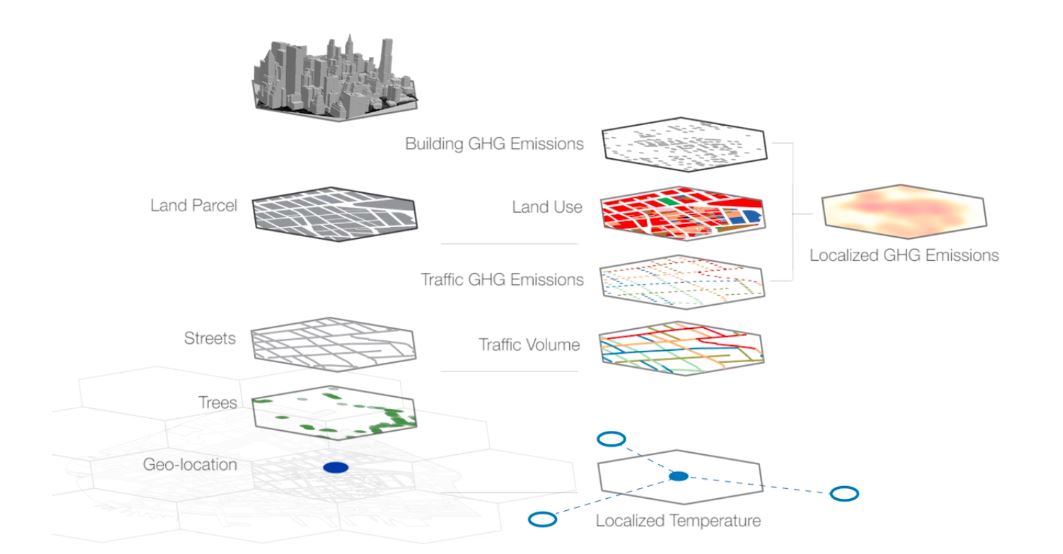
The reduction of energy use and greenhouse gas (GHG) emissions in the urban built environment has emerged as one of the primary grand challenges facing society in the 21st century. The Paris Climate Agreement calls on the global community to limit global temperature rise to 1.5 degrees Celsius through significant reductions in carbon emissions. Given the need for immediate action, cities and urban areas are increasingly taking the lead in addressing this challenge, as cities are positioned to make substantial impacts through improvements to building and transit efficiency, and face dramatic consequences of inaction through increased risk from sea-level rise and extreme events.
To achieve these goals, new data-driven methodologies are needed to identify and target efficiency and carbon reduction opportunities in the built environment at the building, neighborhood, and city-scale. Our approach combines data science, engineering, and urban planning to harness and interpret this “data deluge” coming from cities, including public, private, and citizen-generated sources, with the aim of advancing carbon reduction goals in a way that is efficient, scalable, and rapidly deployable. Our model integrates data from numerous “big” data sources and develops data-driven and physical models of energy and carbon emissions in buildings and transportation to generate a first-of- its-kind high resolution hourly model of urban carbon emissions. This tool is designed as a prototype to support city leaders and urban policymakers with an unprecedented view of localized carbon emissions to enable data-driven and evidenced-based climate action based on rigorous scientific models.
The project won Best Data Visualization Award in United Nations Global Pulse Data for Climate Action Challenge
Back